Physical Address
304 North Cardinal St.
Dorchester Center, MA 02124
Physical Address
304 North Cardinal St.
Dorchester Center, MA 02124

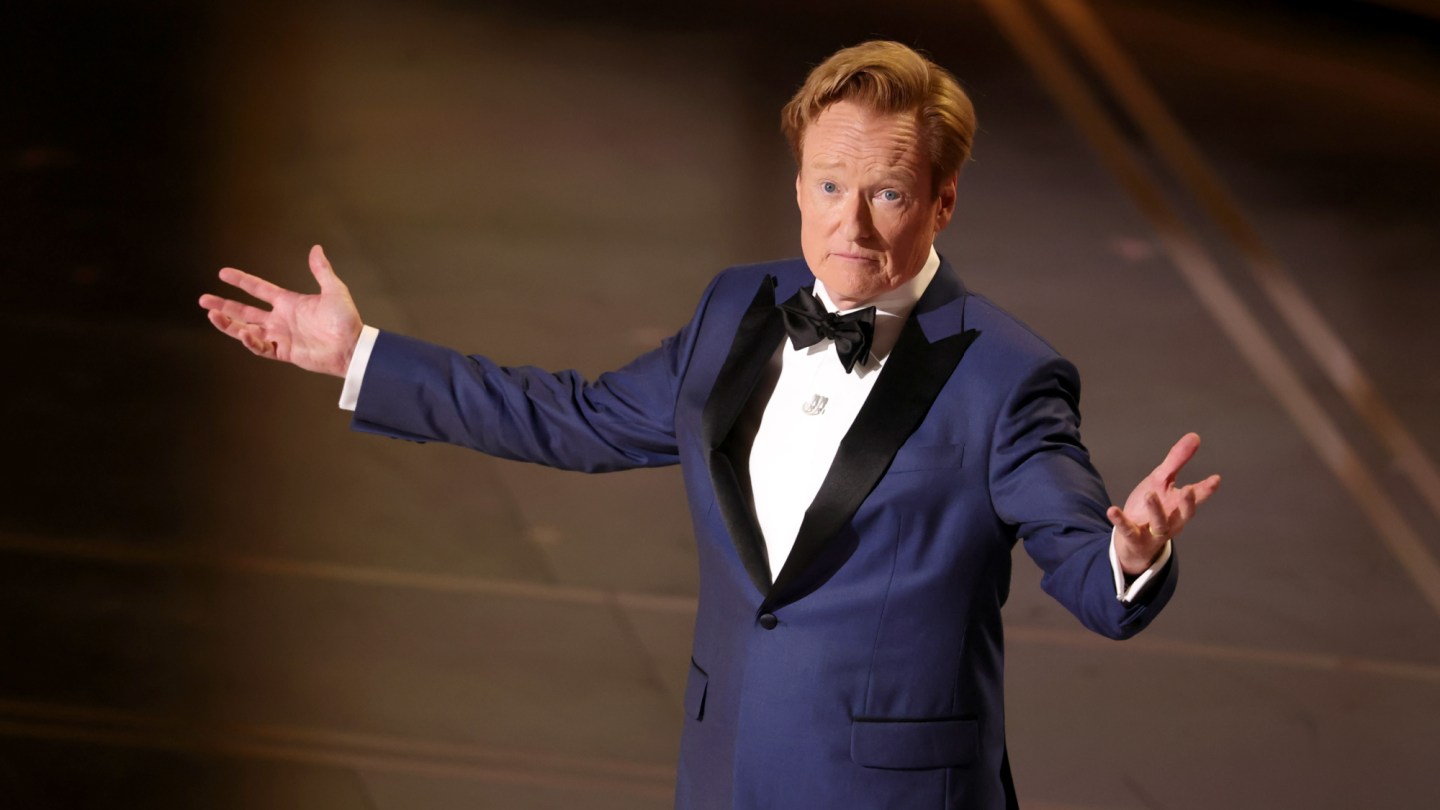
OK, so it’s not like ICE and Iran made zero appearances Sunday night.
A documentary winner called out “a government murder[ing] people on the streets of our major cities,” the international Oscar winner noted that “all adults are responsible for all children and let’s not vote for politicians who don’t take this seriously” and Javier Bardem said “no to all war.”
But these were mostly lesser-knowns or, in Bardem’s case, an international figure, making mostly telegraphed or vague comments. The dozens of American Hollywood personalities who took the podium to open an envelope or accept its bounty mainly just said no to all commentary.
Turn on the show oblivious to current events and you’d never have guessed the U.S. just launched a war whose heat ratchets up by the day. You’d never suspect government agents have been snatching Americans on the streets for months. If that happened, surely we’d hear a passionate deriding of a foreign regime, or a broadside against U.S. government policy, or … something. Not nothing.
One late-night host did flex the muscle. Jimmy Kimmel sidestepped these two major issues but mocked the vanity of a docu-chasing White House and censoring ways of a TV mogul. He was on a lonely island. And not the good Andy Samberg kind.
It’s not like Conan O’Brien didn’t give the room the opportunity; hell, he practically invited them to drop some Bad Bunny beats. “I should warn you, tonight things could get political. So there’s an alternate Oscars hosted by Kid Rock at the Dave and Busters down the street,” O’Brien riffed in his opening. But no electric poles were climbed. If God’s blessing was given to Latin America, we didn’t hear it.
“Conan gave them license to do it and they didn’t take it, and I found that very disappointing,” says the German-born, New York-dwelling writer Daniel Kehlmann, who last year came out with a well-regarded historical novel, The Directorabout filmmakers and totalitarianism and also just published a New York Times opinion piece about the social value of award-speech advocacy. “The whole thing to me felt small, as if there was some psychological wish to pretend this was not a big show but a small community and it doesn’t matter what they’re doing. But it’s not a small thing. It’s a big thing with reach around the world.”
I mean, It’s not like the night’s major award winner has anything to say about nativism and white nationalism and purging the country of immigrants — oh wait.
It’s not like the room everyone was gathered in was being threatened as a result of the Iran war — oh wait.
Agree with him or not — and his line about how the war was “radicalizing the regime” in Iran was…a little hard to parse — but at least Bardem tried to say something, telling THR’s Tiffany Taylor on the red carpet how he saw in the war in Iran a repeat of the war in Iraq.
Couldn’t somebody have made a more coherent claim against the war from the podium? Couldn’t someone maybe have talked about the repression of the leaders of Iran on the other hand? I mean, Jafar Panahi was right there. The husband-and-wife filmmakers behind the Iranian doc short Cutting Through Rocks, who had faced their own tribulationswere right there.
Yet none of the winners could be bothered to say anything with the microphone those nominees only wish they had. None of the cushy speakers could even be bothered to salute them for bravely making the movies they did lest it cause some minor career blowback. “I gave up Christ for you and you couldn’t give up the Mets?”
Hen Mazzig, the pro-Israel influencer who has been vocal politics at award ceremonies, sent me this thought shortly after the show. “As celebrities, who live a luxurious life that only most people can dream of, made catchy statements for peace and ceasefires, they did not utter a single word about the tens of thousands who were murdered by the regime in Iran over the past few months. Not even about the schoolgirls killed by a mistaken American attack two weeks ago, or the hundreds of girls who were poisoned and murdered in the last 47 years by this oppressive regime.”
I get it. Iran doesn’t lend itself to easy soundbites. You don’t want to appear to be supporting a war and you don’t want to be seen as supporting a brutal regime. (Well, most people don’t.) If only there was a place where we might find people who could sell a complex message, a place where the world’s greatest communicators and performers could be found.
I also get it on the fool-me-once front. Stars have been told to shut up and sing since the George W. Bush days, and when they didn’t listen during the first Trump administration they got social movements and Biden — and then it all boomeranged back to Trump anyway. Since then celebrities have been increasingly told that they shouldn’t weigh in on politics — mainly by publicists worried about the ratio. The right has laid down a brilliant trap to movie stars — make comments and you feed into their narrative and make yourself an easy target for the stay-out-of-politics lines (from infotainment anchors waiting for the call to join the Cabinet at any moment).
The problem is that saying nothing also helps their cause — makes you seem irrelevant by your timidity. Talking about the beauty of cinema and the collaboration of co-stars while wars rage at home and abroad has the effect of making you look out of touch. You don’t get slammed on Fox News. You get something worse — not talked about at all.
In such an environment one might have just imagined going for it — pithily knocking ICE or nuancedly characterizing Iran. Not just a boring, vaguely complicit silence.
You might think that silence would have little effect on the real world. Kehlmann vocally disagrees.
“The Oscars are not an internal American thing. It’s really a signal that goes out to the whole world,” he says. “If people watching in Turkey and China and Russia and other non-democracies see that Americans are speaking out, they believe they can too. And if they see they’re not, they think ‘well, America doesn’t have democracy anymore, so why should we?’ ‘People can get rounded up on the streets and no one will care.’ It really has a profound effect. On authoritarian governments too.”
That effect could apply, he says, even in America. “The screws always get more tightened when you’re quiet. This year at least people could speak out at the Oscars. But next year you might get bleeped for saying anything political. And the year after you have to say something pro-government or you’re not eligible for an award. I hope it doesn’t go that way, of course,” Kehlmann adds. “But they’ll always take away freedom if you let them. If you resist they often won’t.”
Look at PTA. You have to love the guy. He makes movies with gusto and tackles issues with flair. And OK, maybe he didn’t want to mar his first Oscar speech after a 30-year wait with talk about ICE. But then he gave another speech. And another. When he got up for best picture and said he forgot something essential in his speech for best director, I thought, finally. Finally, we’re going to get the shout-out to what’s happening on the streets of this country that we’ve been waiting for all season. But then he just said he forgot to thank his cast.
Dude, I’m going to assume at this point the cast knows they’re appreciated. If they don’t, that’s a bigger problem. But you know who doesn’t know and might like to hear some appreciation? The people on the front lines fighting the kind of Steven Lockjaw nativism you so elegantly skewered in your film. They could have really used that shout-out from that big megaphone you had. You know who else could have used the shout-out? The people watching from the “31 countries across six continents [that] are represented this evening,” as Conan noted, who might want to hear we’re not, as a culture, about rounding up people because of their last name or skin color. Instead they heard how you love actors.
Oscar season began in a record-breaking month for ICE deportations and its nominations were announced the weekend Alex Pretti was killed by ICE. The justifiable fury over that incident was probably one of the reasons One Battle won in the first place. And yet, nothing from any of the movie’s winners.
It’s telling that the winner who could have made the biggest political statement, Sean Penn, wasn’t there. Penn won for playing the kind of political figure we don’t want to become, and wasn’t present to drive the point home. Yet his absence from the show, apparently to visit President Volodymyr Zelenskyy in Ukrainecould still have been a beautiful opportunity to shine a light back on a crisis that has become all too forgotten. Instead no one explained anything, the opportunity was botched, and it left us with nothing but presenter Kieran Culkin making a boneheaded comment that sounded like Penn thought he was too good for the show.
Perhaps the most pointed comment of the night came from Will Arnett, who took aim at another threat hovering over the room. “Tonight we’re celebrating people, not AI,” he said, citing animation as “an art form [that]…needs to be protected.” Given the composition of the audience, that perhaps wasn’t the boldest stance. But given the way Big Tech increasingly owns Washington — and given the way it owns the people who employ the winners — it was hardly a safe comment either. Arnett was putting his rep on the line to ensure that there will still be people to honor at the Oscars.
But maybe he should stop fighting so hard. We’re all worried about an industry/society that is fast becoming too automated. But on the awards-speech score, could an AI avatar and its prompters really have done worse? After all, a synthetic performer trained on the Oscar-acceptance remarks might have at least had a hallucination. At this rate, that might be the only way we conjure up some courage.




